Convergence of an infinite series
An infinite series takes the form
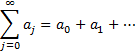
Let
be the nth partial sum of this series. The infinite series converges (i.e. takes a finite value c) provided

In this case, we say that
Our goal is to determine when an infinite series converges.
Note that we can change the initial value of the sum without changing whether the series converges or not. E.g. if 


Alternating Series Test
Property 1: If {a0, a1, …} is an alternating series (i.e. the signs of the terms alternate between plus and minus) with |a0| ≥ |a1| ≥ |a2| ≥ … and 
Proof: Let sn = 

Suppose that a0 ≥ 0 (the proof is similar if a0 < 0 since a1 ≥ 0, and so we can perform the same analysis starting from a1 instead of a0). Define bn = |an| for all n. Thus, the original series is {b0, –b1, b2, –b3, …} where bn ≥ 0 for all n.
Since we have assumed that {b0, b1, b2, b3, …} is a decreasing series, it follows that for any n

It then follows that for any odd value of n

which shows that {s1, s3, s5, …} is an increasing series.
Now for any odd value of n


Note that all the terms in parentheses are positive as is bn, and so sn ≤ b0 for all odd values of n. Since {s1, s3, s5, …} is an increasing series that is bounded above, it follows that the series converges to some finite value s.
Note too that if n > 0 is even, then sn = sn-1 + bn. Since the sn-1 values converge to s (since n–1 is odd) and the bn values converge to 0 (by assumption), it follows that the sn for odd values of n converge to s+0 = s. Thus, all the values of sn converge to s.
Alternating Series Example
By Property 1, the alternating series
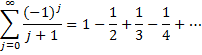 converges. It turns out that it converges to ln 2. Also by Property 1, the series
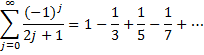
converges. It turns out that this series converges to π/4.
Links
Harmonic Series
The harmonic series
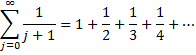
diverges. To see this, note that the infinite sequence of partial sums {s0, s1, s2, …} is an increasing series that is unbounded and therefore diverges. We see that it is unbounded since



Reference
Wikipedia (2016) Series (mathematics)
https://en.wikipedia.org/wiki/Series_(mathematics)